
Driving in vehicle-to-vehicle distance control mode
This mode employs a radar sensor to detect the presence of vehicles up to approximately 400 ft. (120 m) ahead, determines the current vehicle- to-vehicle following distance, and operates to maintain a suitable follow- ing distance from the vehicle ahead.
Note that vehicle-to-vehicle distance will close in when traveling on long downhill slopes.
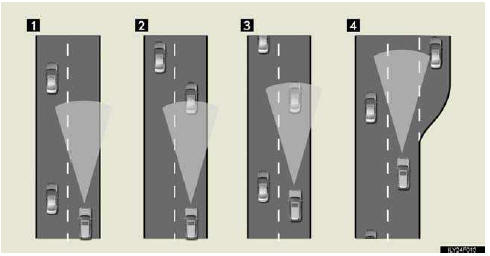
1. Example of constant speed cruising
When there are no vehicles ahead
The vehicle travels at the speed set by the driver. The desired vehicle-to-vehi- cle distance can also be set by operating the vehicle-to-vehicle distance con- trol.
2. Example of deceleration cruising
When the vehicle ahead is driving slower than the set speed
When a vehicle is detected running ahead of you, the system automatically decelerates your vehicle. When a greater reduction in vehicle speed is nec- essary, the system applies the brakes. A warning tone warns you when the system cannot decelerate sufficiently to prevent your vehicle from closing in on the vehicle ahead.
3. Example of follow-up cruising
When following a vehicle driving slower than the set speed
The system continues follow-up cruising while adjusting for changes in the speed of the vehicle ahead in order to maintain the vehicle-to-vehicle dis- tance set by the driver.
4. Example of acceleration
When there are no longer any vehicles ahead driving slower than the set speed
The system accelerates until the set speed is reached. The system then returns to constant speed cruising.
See also:
Destination search by “Emergency�
1. Push the “DEST� button.
2. Touch “Emergency� on the second page of the “Destination� screen.
The display changes to a screen to select police stations, dealers, hospitals
or fire st ...
Natural speech information
Due to natural language speech recognition technology, this system enables recognition
of a command when spoken naturally.
However, the system cannot recognize every variation of each command.
In ...
Transferring a call
A call can be transferred between the cellular phone and system while dialing,
receiving a call, or during a call. Use one of the following meth- ods:
a. Operate the cellular phone.
Refer to the m ...