
Power steering fluid
- Fluid level
The fluid level should be within the appropriate range.
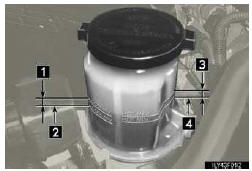
1. Full (when cold)
2. Add fluid (when cold)
3. Full (when hot)
4. Add fluid (when hot)
Hot: The vehicles has been driven around 50 mph (80 km/h) for 20 minutes, or slightly longer in frigid temperatures. (Fluid temper- ature, 140 °F - 175 °F [60 °C - 80 °C]).
Cold: The engine has not been run for about 5 hours. (Room tempera- ture, 50 °F - 85 °F [10 °C - 30 °C]).
- Checking the fluid level
Make sure to check the fluid type and prepare the necessary items.

 Clean all dirt off the reservoir.
 Remove the cap by turning it counterclockwise.
 Wipe the dipstick clean.
 Reinstall the cap and remove it
again.
Reinstall the cap and remove it
again.
 Check the fluid level.
CAUTION
- When checking the reservoir
Take care as the reservoir may be hot.
NOTICE
- When adding fluid
Avoid overfilling, or the power steering may be damaged.
- After replacing the reservoir cap
Check the steering box case, vane pump and hose connections for leaks or dam- age.
See also:
XM NavWeatherâ„¢
The subscription-based XM
NavWeatherâ„¢ service allows the navi-
gation system to display weather infor-
mation on the map screen.
• The following operations can be per-
formed:
• Show XM Na ...
Multi-information display (Optitron meters)
The multi-information display presents the driver with a variety of drivingrelated
data.
Trip information contents
Displays driving range, fuel consumption and other cruising-related infor- mati ...
Typical voice guidance prompts
The voice guidance provides various messages as you approach an intersection,
or other point where you need to maneuver the vehicle.
1. “Proceed about 5 miles to Main
street.�
2. “In h ...